

What if the best solar system for your Perth home isn’t the biggest one your roof can hold? A solar installation Perth homeowners can feel confident about starts with the home, not a standard system size. Roof orientation, shade and condition all matter, as do the times you use electricity and the way your household may change.
Generation estimates and savings claims don’t always tell the whole story. A system’s expected output isn’t the same as the savings on your bill. How much electricity you use while the panels are producing can make a real difference. Perth’s sunny conditions are a helpful starting point, but they don’t make every roof or household routine the same.
This guide covers the local factors that shape a suitable solar system, the household details that make estimates more meaningful, and how to weigh solar-only against solar and battery options. SolarGrid Perth supplies and installs residential rooftop solar, with layouts tailored to your home, roof and energy habits. Use the steps below to prepare for a practical conversation about what could suit your household.
Key Takeaways
- Start with your household’s energy needs, then consider what rooftop solar could contribute to everyday electricity use.
- Roof area, orientation, shade and condition help determine which panel layouts may suit your home.
- Read solar generation estimates separately from bill savings, which also depend on how and when your household uses electricity.
- For a clearer solar installation Perth plan, gather recent power bills and note your main daytime energy use.
- SolarGrid Perth tailors residential solar layouts to household needs and rooftop conditions, with solar-only and solar and battery options.
Is solar installation in Perth a good fit for your home?
Start by considering what your home can accommodate and when you use electricity. Residential solar installation means fitting rooftop panels to generate electricity for household use. A suitable design depends on both the roof and your household’s energy pattern, rather than a standard system size.
Perth’s sunny conditions make rooftop solar worth considering, but sunshine alone can’t predict what a particular home will produce. Weather varies, and panels receive different amounts of sun depending on roof orientation, nearby shade and system design. The roof’s condition and usable space also shape what can be installed.
For a wider view of rooftop solar adoption across Australia, it helps to look beyond one city. Broad information and published generation estimates provide context, not a promise for your home. A useful estimate should reflect your roof and household circumstances.
Perth’s solar potential describes the local opportunity; your roof and energy habits shape your household’s actual results. Keeping those two things distinct helps set practical expectations while you consider solar for your home.
What Perth’s sunny conditions can and cannot tell you
Local sunshine is a reason to explore solar, not a fixed output figure. Cloud cover and seasonal weather affect how much sunlight reaches the panels. Roof direction, shade from trees or nearby buildings, and panel layout can also influence generation. Even two homes on the same street may have different conditions.
Published output figures can help explain what a system might produce under stated assumptions. Treat them as examples, not guarantees. For a meaningful estimate, the assumptions need to reflect your roof and proposed design.
Which household situations may suit rooftop solar?
Daytime electricity use is one useful part of the picture. If someone is home during the day, or appliances regularly run then, some solar generation may be used as it’s produced. If most electricity is used in the evening, the pattern will be different. Neither routine rules solar in or out. It helps explain how your household could use the electricity generated.
Physical conditions matter too. Available roof space, orientation and shade affect where panels can sit and how the layout may be designed. Roof condition belongs in the conversation as well. Each home has its own combination of energy habits and practical constraints, so a suitable plan starts with your circumstances rather than assumptions about a typical household.
How your Perth roof and energy habits shape solar design
A useful solar layout starts with the details that make your home different. The roof determines where panels could sit and how much sun they may receive. Your daily routine helps explain when that electricity could be used. Considering both helps avoid treating panel placement as a one-size-fits-all exercise.
Roof area, orientation, shade, roof condition and household energy habits are the core inputs that shape a rooftop solar layout. These details are more useful for planning a solar installation in Perth than assumptions based on a standard home.
Roof orientation, shade and available space
Different roof faces receive sunlight at different times of day. Nearby trees, buildings or roof features can cast shade, while usable area affects how panels may be arranged. A north-facing roof isn’t the only possible option. East- or west-facing sections may also be considered as part of a tailored layout.
Roof condition matters too. A practical design takes account of the available space and the state of the roof, rather than focusing on direction alone. These factors help guide panel placement without deciding suitability on a single feature.
Match solar generation to the rhythm of home life
Solar electricity is generated during daylight, so the timing of household activity affects how much can be used as it’s produced. A home that runs appliances during the day may use more of its solar generation directly. If most activity and electricity use happen after work, the pattern will be different. Neither routine is automatically a deal-breaker. It’s information that helps shape the design discussion.
Think about an ordinary week, not just an unusual day. Note when people are home and when energy-intensive activities usually happen. For example, do you commonly run the washing machine or dishwasher during daylight, or is the house quieter until evening?
- Consider the usual times for cooking, laundry and other regular appliance use.
- Notice whether anyone is home during the day, including on weekdays.
- Include any planned changes to your household routine that could affect energy use.
This picture connects the roof’s opportunities with the way you live in your home. The Australian Government's Solar Consumer Guide offers broader guidance for household solar decisions. A tailored layout brings the focus back to your roof and routine. SolarGrid Perth designs rooftop solar layouts around household energy needs and roof conditions, so exploring a tailored solar layout is a practical next step once you’ve considered these factors.
How to read Perth solar output and savings estimates
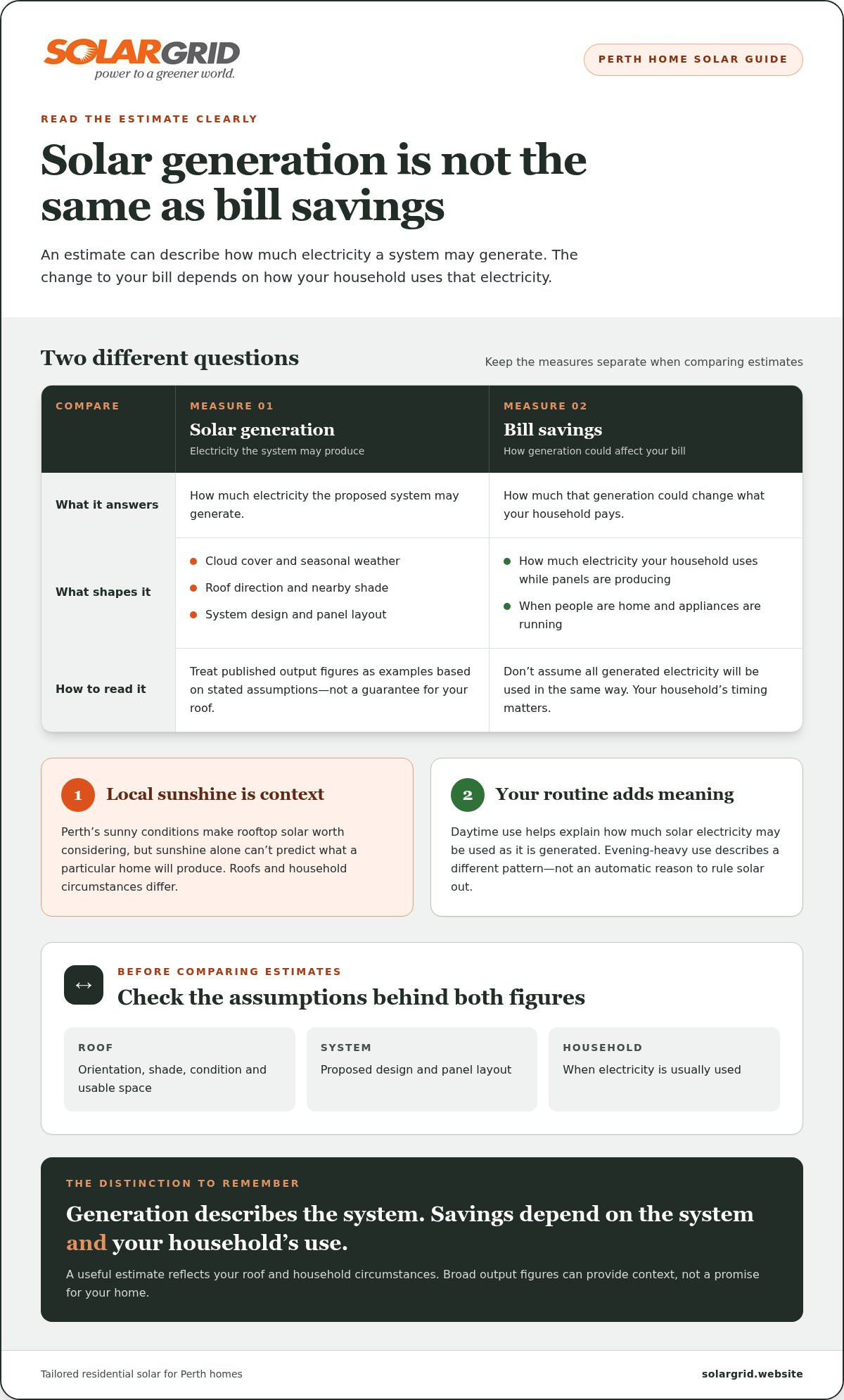
A solar estimate can look precise, but it answers two different questions: how much electricity the system may generate, and how much that generation could change your electricity bill. The figures aren’t interchangeable. A system can produce plenty of power, yet the bill benefit depends on how much your household uses while it’s being generated and what happens to electricity sent to the grid.
For a solar installation Perth estimate, look at the assumptions behind each figure before treating it as a forecast. A daily or annual generation estimate is a model, not guaranteed output. System design, roof conditions and changing weather can affect what’s produced. Perth-wide averages and examples offer context, but they can’t show exactly what your own home will generate.
What a solar generation estimate actually means
Generation is the amount of electricity a proposed system is expected to produce over a stated period. Check whether the estimate is daily or annual and whether it relates to your actual roof layout. Shading, panel direction and seasonal weather can cause real-world production to differ from the model. If a figure uses a standard example rather than your home’s details, read it as an illustration.
Why estimated savings differ between households
Savings depend partly on self-consumption: the solar electricity your household uses directly instead of drawing that power from the grid. Any surplus may be exported, but the value of exported electricity depends on the applicable buyback arrangement. Household routines and the assumptions used for electricity use and tariffs can therefore change a savings estimate.
In Synergy’s Distributed Energy Buyback Scheme schedule published on 1 July 2026, the listed buyback rates are 10 cents per kilowatt-hour during the 3 pm to 9 pm peak window and 2 cents at other times. These rates are time-sensitive, so check Synergy’s current schedule before relying on them. An estimate should make clear what export rate it assumes and how much generation it expects you to use at home.
| Estimate | Underlying assumption | What may change the result |
|---|---|---|
| Solar generation | System design and expected sunlight for the roof | Weather, shade, roof conditions and actual layout |
| Household self-consumption | How much generated electricity is used at home | When people are home and when appliances run |
| Export benefit | How much surplus is sent to the grid and the buyback rate applied | Export timing, scheme terms and current rates |
| Bill savings | Generation, household use, exports and electricity tariff assumptions combined | Changes in usage, tariffs or export arrangements |
Use the table to understand what an estimate includes, not as a promise of a particular bill outcome. Compare like with like. If two estimates use different assumptions about daytime use or exported power, their savings figures aren’t directly comparable. Recent bills can help show how much electricity you use and when, making the assumptions easier to assess.
What to prepare before planning solar for your Perth home
You don’t need every technical detail worked out before discussing solar. A few notes about your home and routine can make the conversation clearer and keep the focus on what matters to your household. Treat this as preparation, not a commitment to a particular system.
Before discussing a solar installation Perth design, gather a snapshot of your energy use and roof. Recent electricity bills can show patterns across different periods, while observations about the home add context. These are useful starting points for planning, not a promise of savings.
Household details that make planning more useful
Keep recent bills together, then note when the home is usually occupied and when larger appliances or other major energy uses run. Add any expected changes, such as a different household routine or new electrical equipment. If the property already has solar panels or a battery, record that too. These details help describe how your needs may look now and later.
A short preparation sequence can make the first discussion more manageable:
- Collect recent electricity bills. Keep the usage information available so you can discuss the household’s pattern rather than relying on memory.
- Note energy routines. Write down when people are home and when major appliances or other significant household loads are typically used.
- Record roof observations. Note visible roof sections, nearby trees or buildings that cast shade, and any known roof work or condition concerns. There’s no need to climb onto the roof.
- List existing equipment and constraints. Mention any solar or battery equipment already at the property, known electrical limitations and planned changes.
Keep the notes simple. For example, “shade reaches the west roof in the late afternoon” is more useful than trying to estimate how much electricity a panel might generate. A clear description helps guide the discussion without requiring you to do the technical assessment yourself.
Questions that clarify a tailored solar proposal
Use your notes to understand how a proposed design relates to your home. Ask how the panel layout responds to the roof’s usable space, orientation and shading, and how it reflects the times your household uses electricity. It’s also useful to understand the assumptions behind the generation estimate and which roof or weather conditions could change the result.
For grid connection steps and current requirements, refer to Western Power’s latest guidance. Connection arrangements can depend on the proposed system and property, so avoid relying on an old summary or an estimate that leaves its assumptions unexplained.
With your household notes in hand, you can discuss a layout shaped around your roof and energy needs. Discuss a tailored solar installation with SolarGrid Perth when you’re ready to explore what could suit your home.
SolarGrid Perth: a tailored solar installation for your home
Choosing solar is a household decision, not simply a matter of selecting panels. SolarGrid Perth supplies and professionally installs residential rooftop solar in Perth, with layouts tailored to the home and the people who live in it. The planning brings roof conditions and everyday energy needs into the same conversation.
A useful design needs to make sense in practice. Your roof may have several usable sections, changing shade or limited clear space. Household electricity use has its own rhythm too. A tailored plan considers how these details fit together instead of assuming every home needs the same layout.
A residential system shaped around your home
SolarGrid Perth designs rooftop layouts for household energy production, taking roof conditions and energy needs into account. Sharing what you know about your routine can make the discussion more grounded: whether power is used during the day, which roof areas are affected by shade, and whether the household’s needs may change.
A useful conversation focuses on how a proposed layout relates to your home, not on promising a particular bill reduction or level of output. Generation depends on system design and conditions at the property, while bill outcomes also reflect how the household uses electricity. Clear expectations make it easier to consider the options on their merits.
SolarGrid Perth installs standalone solar systems as well as combined solar and battery systems. Start by considering what you want the system to do for your household. You don’t need to make battery decisions before the broader picture of your roof, energy use and preferences is understood.
A household-first approach also makes a proposal easier to follow. You can discuss why a particular rooftop layout is being considered and how it relates to your home, rather than interpreting a generic system description on its own. A tailored solar installation Perth plan should connect the design to the details you’ve shared.
A simple next step for Perth homeowners
Begin with a few practical details: how your household uses electricity, what you know about the roof, and any existing solar or battery equipment. Recent bills and brief notes about daytime use can give the discussion a useful starting point. You don’t need every answer ready.
From there, the conversation can focus on what matters to you, whether that’s understanding a proposed layout, considering solar on its own or exploring a combined system. You can talk through your home’s circumstances and get a clearer sense of what a tailored installation involves.
If you’re ready to explore solar for your home, talk with SolarGrid Perth about a tailored installation. Bring your questions and what you’ve learned about your household. The conversation can start before you’ve decided on every detail.
Take the next step towards a solar-ready home
A useful next step doesn’t need to begin with a firm decision. Start by considering what you want your home’s energy setup to do, now and as your household changes. The aim is to explore options that feel practical for your place, rather than choosing a system based on a headline estimate or standard package.
SolarGrid Perth focuses on residential solar and home battery installation in Perth, with rooftop layouts tailored to household energy production. Your roof and the way you use energy can guide the discussion, whether you’re considering solar on its own or a combined system. Bring the questions that matter most and talk through a design at a comfortable pace.
If solar feels like a possibility for your home, a conversation about solar installation Perth can help turn the information you’ve gathered into a clearer direction. You don’t need every detail settled first.
Talk with SolarGrid Perth about a tailored solar installation. Share your household’s energy needs and what you know about the roof to start planning a system for your Perth home.
Frequently Asked Questions
Can rooftop solar panels generate electricity on cloudy days?
Yes, rooftop panels can still generate electricity in cloudy conditions, although they generally produce less than in strong sunlight. The amount depends on cloud cover, the system’s design and conditions at your property. A Perth-wide average can’t predict the output of an individual roof. Treat a generation estimate as an indication, not a guarantee, and look at assumptions such as roof direction and shading.
Will solar panels keep working during a power outage?
Not necessarily. A standard grid-connected solar system may shut down during a network outage as a safety measure, so don’t assume panels alone will provide backup. Whether your home can use solar power during an outage depends on system design and compatible equipment. If keeping selected household essentials running matters to you, raise backup needs as a separate requirement when discussing solar or battery installation.
How long does a solar installation take in Perth?
There isn’t one timeframe that applies to every Perth home. Time on site depends on factors such as roof access, system design and any electrical or connection work involved. The overall project may also include planning and network steps that happen outside the installation visit. Discuss the expected sequence and timing for your property before work is scheduled, so you can plan around access and household routines.
Can solar panels be installed on a tiled roof?
Yes, tiled roofs can be suitable for solar, but the roof material alone doesn’t settle the question. Roof condition, usable space, layout and installation requirements all affect the design. For example, a tiled roof with several small sections may need a different panel layout from one with a broad, unobstructed area. An assessment of the individual roof helps identify practical considerations before the design is settled.
Do solar panels need regular cleaning in Perth?
Not every home will need the same cleaning routine. Rain may wash away some surface dust, while nearby trees and local conditions can contribute leaves or other debris. Follow the panel manufacturer’s care guidance, and don’t climb onto the roof or use unsuitable cleaning methods. If you notice a change in performance, check system monitoring if available and arrange appropriate professional support where needed.
Can I add a home battery to solar panels later?
In many cases, a battery can be added to an existing solar system, but compatibility depends on the equipment and how the system was designed. The upgrade may also involve additional components or electrical work. Before exploring battery storage, gather the details of your current solar setup, including equipment information if available. That gives the proposed arrangement a clearer starting point, without assuming every existing system can be adapted in the same way.
Does a Perth home need Western Power approval for solar?
Connection requirements depend on the proposed system and Western Power’s current processes. Applications or technical requirements may apply, so don’t assume the process is identical to another home’s or rely on older advice. For a solar installation Perth project, check Western Power’s latest guidance and make sure the relevant connection steps are included in the project plan. Requirements can change, so confirm the applicable process when arranging an installation.