

A bigger solar system isn’t automatically a better fit for your Perth home. The right solar system size for home Perth households need depends not only on how much electricity they use, but also when they use it and what their roof and local grid connection can support. A typical 6.6 kW system produces around 26-29 kWh a day on average in Perth, but that doesn’t make it the right match for every household.
If you’re unsure how to turn your electricity bill into a system size, you’re not alone. It’s sensible to aim for enough solar to suit your needs without paying for capacity that doesn’t fit your home. Start by looking at your daily usage and household routines, then consider your roof space and Western Power’s connection and export requirements.
This guide explains how to estimate a practical starting size from your electricity use and what could change that estimate. You’ll learn how daytime demand, roof conditions and network requirements affect the design, and what information to gather for a tailored Perth system. SolarGrid Perth designs and installs rooftop solar systems around each household and local conditions, helping turn an estimate into a considered fit for your home.
Key Takeaways
- Estimate a sensible solar system size for home Perth needs by starting with your electricity use, not a one-size-fits-all recommendation.
- Use a full year of Synergy bills to spot seasonal changes in your household’s electricity demand.
- Consider when you use power, as air-conditioning, a pool or an EV can affect both your overall usage and daytime needs.
- Understand how panel capacity, inverter capacity, roof layout and your home’s electrical setup shape the final design.
- Gather your bills, interval data, roof details and future household plans to help guide a tailored solar layout.
What does solar system size mean for a Perth home?
Solar system size refers to the combined rated capacity of the panels, measured in kilowatts (kW). It describes their potential power under standard testing conditions, not how much electricity your household will use or how much the system will produce on a particular day.
Installed capacity is the panels’ rated power in kW; electricity produced or used over time is measured in kilowatt-hours (kWh). Keeping these units separate makes solar estimates easier to understand and helps you compare system capacity with the electricity use on your bill.
Solar capacity and household electricity use are different measures
Think of kW as the rate at which power can be generated or used at a moment, and kWh as the amount of energy accumulated over time. For example, a household might have panels with a combined rated capacity of 5 kW and use 20 kWh of electricity over a day. The figures describe different things: this example doesn’t predict how much the panels will generate or what the household will save.
A solar system won’t deliver its full rated capacity constantly. Sunlight changes throughout the day, so panel output rises and falls. A clear midday period may produce more power than early morning or late afternoon, while cloud, heat, shade and other site conditions can affect generation. The inverter and overall system design also influence how panel output is converted for household use.
For background, rooftop photovoltaic systems combine solar modules with other components, including an inverter. In a home design, panel capacity and inverter capacity are related, but they aren’t interchangeable measures.
Why Perth’s location matters when estimating solar size
Perth’s sunshine patterns help estimate how much electricity a system may generate across a year, but they don’t guarantee a fixed daily result. The same system can produce different amounts from season to season. Even homes with similar-sized arrays can have different outcomes because their roofs and layouts differ.
Orientation affects when sunlight reaches the panels. Shade from trees, nearby buildings or roof features can reduce the available sun, while the amount and placement of usable roof space shape the array layout. These details matter alongside household electricity use when estimating a solar system size for home Perth conditions can support.
There’s a separate network consideration, too. Local connection requirements can affect system design and how much electricity can be exported to the grid. Export capacity isn’t the same as panel generation: it concerns power sent out rather than used in the home. Treat an early estimate as a guide, then refine it around your roof, daily routines and connection conditions.
How to estimate solar system size from your Perth electricity use
Your electricity bill is a useful starting point, but one billing period won’t tell the whole story. Begin with the energy you use, then compare it with an indicative Perth solar-generation estimate. The result is a planning guide, not a final system recommendation: your roof, connection conditions and the times you use power still matter.
Turn your electricity bill into a starting estimate
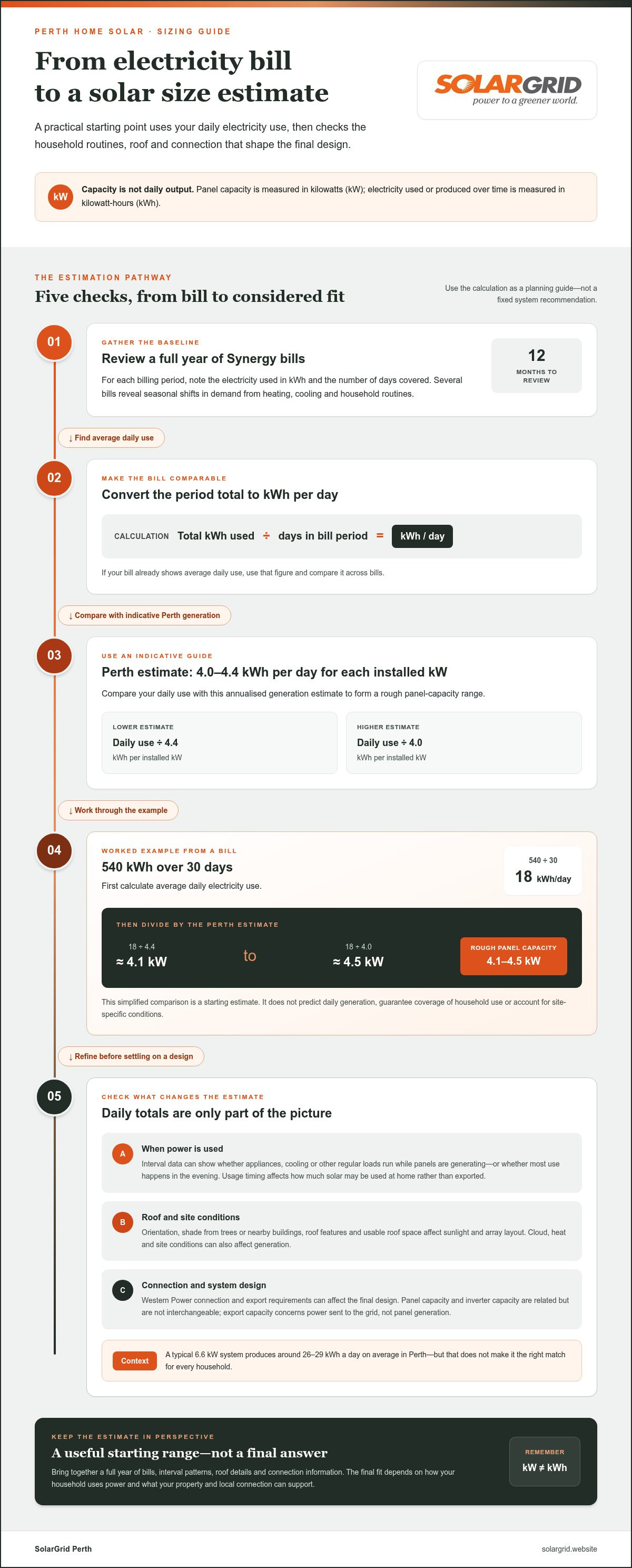
Look on a Synergy bill for your electricity use in kilowatt-hours (kWh) and the number of days in the billing period. If the bill doesn’t show average daily use, divide the total kWh by the number of days. Check several bills across a full year, as heating, cooling and other seasonal routines can change household demand.
Next, compare that daily figure with Perth’s indicative annualised generation estimate of around 4.0-4.4 kWh per day for each installed kW of solar panels. The Australian Government’s guide to sizing a home solar system also explains how electricity use informs an initial system estimate.
Indicative calculation: if a household uses 540 kWh over a 30-day bill period, that averages 18 kWh per day. Dividing 18 by the estimated 4.0-4.4 kWh produced per installed kW gives a rough range of about 4.1-4.5 kW of panel capacity.
This simplified comparison doesn’t promise that the panels will generate that amount every day or cover all household use. It assumes the annualised Perth estimate applies to the site and doesn’t account for usage timing, roof shading, orientation or connection conditions. Use it as a starting point for estimating the solar system size for home Perth needs, not as a fixed answer for every property.
Use smart meter data to account for when power is used
Daily totals show how much electricity the home uses, but not when it’s needed. If interval data is available through your meter or electricity account, review usage across the day. This can show whether appliances, cooling or other regular loads operate while panels are generating, or whether most consumption happens later in the evening.
Usage timing helps explain how much solar might be used directly in the home rather than exported. Two households with the same daily total may have different patterns, so a daily-use calculation alone can miss an important part of the picture. At this stage, you’re not sizing a battery; you’re finding out when your household needs power.
Bring your bill average and interval patterns together with roof details and connection information before settling on a design. SolarGrid Perth tailors residential rooftop layouts to household needs and local conditions, turning a first estimate into a considered Perth rooftop solar layout.
Which Perth household and roof factors can change your solar size?
Household size is only a rough guide to electricity use. Two homes with the same number of people can use power very differently, depending on appliances, routines and how much electricity they need during daylight. To estimate a useful solar system size for home Perth households should consider both total consumption and when it happens, then check what the roof can accommodate.
Match system planning to household routines and future changes
Air-conditioning can add to electricity use, especially during hot weather. A pool pump may create a regular daytime load if it runs while panels are generating. An electric vehicle (EV) can raise future demand, but the effect depends on charging habits: charging at home during the day creates a different pattern from charging mostly after sunset.
Compare your actual routines rather than choosing a size based on a household label. A home where someone is usually present, or where appliances run during the day, may be able to use more solar generation directly. If the house is quiet until evening, daytime use may be lower even if the daily total is similar.
Consider planned changes as well. A new EV, replacing gas appliances with electric models, or adding air-conditioning could shift future demand. Treat these as likely changes to plan around, not as electricity use you already have. Energy Policy WA and Synergy household benchmarks illustrate the range: they put small households at around 12-15 kWh per day, medium households at 18-22 kWh, and larger homes with features such as ducted air-conditioning, a pool or an EV at 28-45 kWh or more. These are broad reference points, not system-size recommendations. A larger array makes sense only when household needs, roof capacity and connection conditions support it.
Keep battery capacity as a separate decision. Solar panels describe generation capacity; a battery stores electricity for later use. If storage is part of a future plan, include it when estimating solar rather than treating a battery as a substitute for matching the panels to household demand.
Check usable roof space, orientation and shading
The roof’s total area isn’t the same as the area available for panels. Roof sections, vents and other features affect where an array can fit, while shade from trees or nearby buildings can limit sunlight on particular parts of the roof. The practical layout depends on the clear, suitable space, not just the roof’s overall footprint.
Direction also shapes when panels receive sunlight and how generation is spread across the day. A roof with more than one suitable face may allow panels to be arranged across different orientations, while shade can make some sections less useful than others. These details affect both the available panel capacity and the generation estimate, so a simple roof-area measurement can’t settle the design on its own.
Before settling on a size, bring together your usage patterns and future plans with roof information and connection details. SolarGrid Perth tailors residential rooftop layouts to household needs and Perth conditions, helping turn an initial estimate into a design that fits your home.
How Perth roof, inverter and network limits shape the final system
Your usage estimate is a helpful starting point, but it doesn’t settle the final design. The roof determines where panels can sit, the inverter helps manage the electricity they produce, and the home’s connection can affect system operation and the export of surplus power. These elements need to work together.
Understand panel capacity, inverter sizing and the home connection
The panel array is the combined rated capacity of the solar panels, measured in kilowatts (kW). The inverter converts their output into electricity your home can use. Its capacity is rated separately, so the array’s kW figure and the inverter’s capacity aren’t interchangeable. Their relationship is part of the design, and neither figure means the system will always produce at its rated level.
The roof layout, electrical setup and connection details help determine which arrangement is suitable. Available roof faces affect where panels can be placed, while the property’s phase and existing electrical equipment can influence connection options. A site assessment brings these details together with household use, rather than treating panel capacity as a standalone number.
Panel capacity describes the array; inverter capacity describes the equipment converting its output, and the home’s connection helps determine how the system can operate. This distinction is useful when comparing proposed designs. A larger panel figure alone doesn’t show how much electricity the home can use at once or export to the network.
Check current Western Power requirements before finalising a size
In Perth, Western Power’s connection requirements can shape inverter settings and the amount of electricity a home can send to the grid. Its current guidance includes different export arrangements, with settings depending on the connection and local network conditions. Some connections may have a lower export allowance, so don’t assume every surplus kilowatt-hour can flow to the grid.
For context, Western Power’s published requirements describe a standard dynamic export limit of up to 5 kW for a single-phase property and a net 5 kW across phases for a three-phase property with an active retail offtake agreement. Where dynamic management isn’t available or a local network is constrained, a static limit of 1.5 kW, or in some locations no export, may apply. These are connection limits, not measures of the panels’ total capacity. Western Power requirements can change, so current guidance and the property-specific connection outcome should inform the final design.
Local network approval can affect a system’s export settings, so current Western Power requirements for the property should inform the final design. The connection process establishes what the local network can accommodate; it doesn’t mean a larger system can always export all its surplus generation.
SolarGrid Perth tailors rooftop solar layouts to household needs and Perth conditions. Explore a tailored rooftop solar design that accounts for your roof and connection details.
Turn your Perth solar size estimate into a tailored home system
Your estimate gives you a place to begin, not a system size you’re locked into. To make it more useful, bring together a year of electricity use, the times you draw power, details about your roof and any household changes you’re planning. These details help shape a design around how your home actually runs.
Prepare the details that make a system estimate more useful
Gather information that shows both your energy use and the conditions at your property. A clear set of notes makes it easier to move from a rough calculation to a tailored layout. Include:
- A full year of electricity bills, including the kWh used and billing dates.
- Smart meter interval data, if available, to show when your home uses power.
- Roof details such as the sections you’d like considered, known shade, and any visible obstructions.
- Regular daytime loads and likely future changes, such as an EV or new electric appliances.
A few practical observations can help, too. Note when air-conditioning or pool equipment usually runs, whether the home is occupied during the day, and any roof areas you know are shaded. You don’t need to turn these notes into a technical plan; they simply explain the household behind the electricity figures.
If you’re preparing for an installation, keep these details together with your questions and site information. A solar installation preparation checklist can help organise what you want to discuss, from household routines to roof concerns.
Move from an estimate to a home-specific solar layout
A tailored layout brings household information together with the physical details of your property. SolarGrid Perth designs and installs residential rooftop solar systems around each home’s requirements and Perth conditions. The initial usage estimate is considered alongside usable roof space, panel placement and the home’s electrical setup, rather than treated as a complete answer on its own.
Connection requirements matter as well. Current Western Power rules and the property’s network conditions can affect the final design and export settings. These considerations refine the estimate into a layout suited to your home. The aim is a considered design, not simply the largest array that appears to fit or a standard size applied to every household.
Bring your information as it is. If you’re still weighing up future changes or don’t have interval data, your starting estimate can still help guide the design. Household needs and site conditions can be considered together as the layout takes shape.
Ready to take the next step? Talk with SolarGrid Perth about a tailored solar system for your home.
Choose a system that can grow with your plans
A solar decision doesn’t have to answer every future change at once. Think about how you expect to live in your home over the next few years. If you’re considering an electric vehicle or moving more household tasks to daytime, include those plans in the system design. This helps make the estimate relevant to how you expect to use power, not just your current routine.
The right solar system size for home Perth households choose should suit their current needs and the practical conditions at their property. You don’t need to have every detail settled before starting. A considered design can turn your early estimate into a residential solar installation planned around your home.
Talk with SolarGrid Perth about a tailored solar system and take the next step towards solar for your home.
Frequently Asked Questions
Can I add more solar panels to my system later?
Possibly, but adding panels later depends on whether your existing inverter, roof space and electrical connection can accommodate them. The new panels also need to work appropriately with the system already installed. For example, panels on a differently oriented roof section may receive sunlight at different times from the original array. Before planning an extension, have the existing equipment and proposed layout assessed so the addition is designed to suit the whole system.
Is a 6.6 kW solar system the largest allowed in Perth?
No. A 6.6 kW panel array isn’t a blanket maximum for Perth homes. The final options depend on the inverter, the property’s electrical connection and current Western Power requirements for that location. Panel capacity and inverter capacity are measured separately, so a panel figure alone doesn’t establish what can connect or export. Treat 6.6 kW as one possible system size, not a universal limit or a fit for every home.
Do solar panels produce enough electricity in a Perth winter?
Solar panels still generate electricity during Perth’s winter, but shorter days, cloud and other site conditions can reduce output compared with sunnier periods. Whether winter generation meets your needs depends on your system design and how much electricity your household uses at that time. A household that runs heating in the evening may draw power from the grid after solar production falls. Reviewing winter bills can help reveal this seasonal pattern.
Can rooftop solar power my home during a blackout?
Usually, a standard grid-connected solar system switches off during a grid outage. This protects workers and equipment while the network is being repaired. Solar panels alone therefore shouldn’t be relied on to keep household circuits running in a blackout. Backup power requires a system designed with suitable battery and backup functions, and the circuits supported can depend on that design. If outage power matters to you, include it as a specific requirement when planning your system.
What happens to extra solar electricity my home does not use?
Surplus electricity may be exported to the grid, subject to the connection’s export settings. If export is limited, the system may need to reduce what it sends out when the limit is reached. Synergy’s DEBS schedule lists daytime exports at 2 cents per kWh and exports from 3 pm to 9 pm at 10 cents per kWh, subject to scheme conditions and its daily cap. Export credits depend on your applicable arrangement.
Can I estimate my solar system size from one electricity bill?
Yes, one bill can give you a rough starting estimate, but it can’t show whether that period was typical for your home. A bill covering a hot spell, for instance, may reflect heavier air-conditioning use than a mild month. Check the dates and total kWh, then compare them with bills from other seasons before settling on a solar system size for home Perth conditions. A full year gives a more balanced picture.

